Why Is There Standing Water in My Yard?
A wet patch that won’t dry out can mean a dozen different things, and only some of them involve your septic system. Here’s how to tell the difference before you assume the worst — or ignore something that actually needs attention.
It’s Not Always the Septic System — But Often It Is
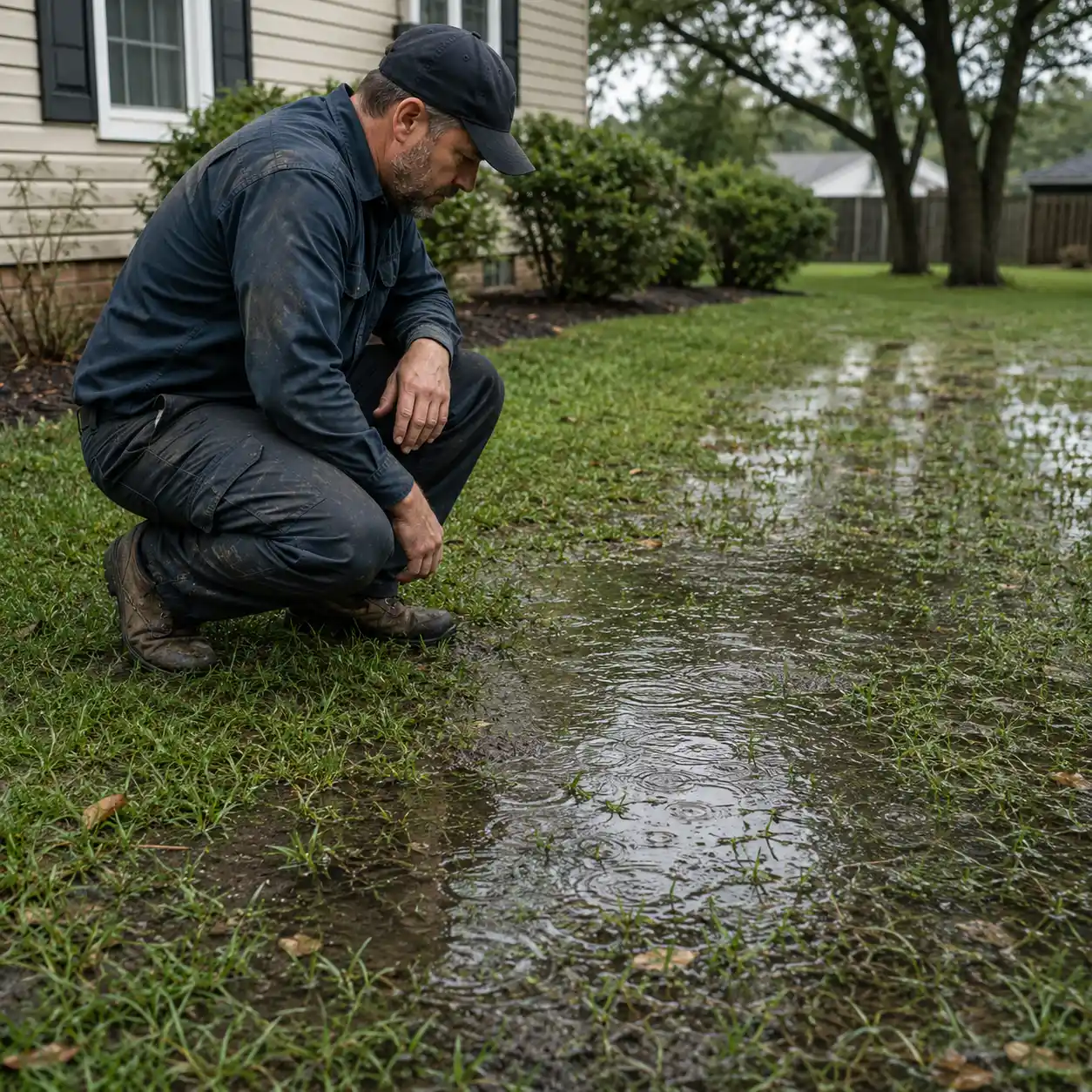
Most homeowners who search for this are standing in the yard looking at a patch of ground that just won’t dry out, wondering if they’re about to be told they need a new drain field. That reaction makes sense. A soggy yard is one of the more visible septic warning signs, and once you’ve heard that phrase, every wet spot starts to look like an emergency.
What the quick internet answer usually leaves out is that standing water has several genuinely different causes, and only a few of them involve the septic system at all. Simple grading problems, clay soil that drains slowly under any circumstances, and even a leaking irrigation line can all produce the exact same visual as a struggling drain field. The location of the water, how it smells, and how long it’s been there tell you far more than the water itself does.
Likely Causes
A Saturated or Failing Drain Field
If the wet area sits directly over where your drain field is located, and it stays wet well after the ground around it has dried, this is the cause worth ruling out first. A drain field disperses treated wastewater into the surrounding soil through a network of trenches. When the soil in those trenches can no longer absorb liquid at the rate the household is producing it, water backs up and surfaces at the ground level instead of soaking in. On the red clay common through Cherokee, Forsyth, and the surrounding counties, this soil has less absorption capacity to begin with, so a field here has a narrower margin before saturation becomes visible above ground.
A Shifted or Clogged Distribution Box
Wastewater doesn’t flow evenly into a drain field by accident. A distribution box, sometimes called a D-box, sits between the tank and the field and splits outgoing flow across each trench. If that box shifts out of level or gets partially blocked, one trench can end up handling far more liquid than it was designed for while the others sit underused. The result is often a wet spot over just one section of the field rather than the whole thing, which is actually a useful clue when you’re trying to describe the problem to a technician over the phone.
A System Handling More Water Than It Was Designed For
Septic systems are sized around an expected household size and water use. A system built for a three-bedroom home used by two people works differently once that home has five occupants, a garbage disposal running daily, and a laundry routine that didn’t exist when the system was installed. None of that shows up as a single dramatic event — it shows up gradually, as a drain field that’s now being asked to process more liquid than its original design accounted for, until eventually it can’t keep up.
Poor Surface Grading Near the Field
Not every wet spot near a drain field is coming from the field itself. If the surrounding yard slopes toward that area, or if a downspout empties nearby, ordinary rainwater runoff can collect right on top of the field and make a perfectly healthy system look like it’s failing. This is worth checking before assuming the worst, since it’s a landscaping fix rather than a septic repair.
What It’s Probably Not
Ordinary Clay Soil Drainage
Piedmont red clay is genuinely slow to drain, full stop, regardless of what’s happening underground. A low spot in the yard that’s nowhere near the septic system and has always been a little soggy after rain is probably just clay behaving like clay. The key distinguishing factor is location — water that has nothing to do with your system’s layout is unlikely to be caused by it.
Temporary Saturation After Heavy Rain
A healthy drain field can still look temporarily overwhelmed after a genuinely heavy rain event, especially on clay soil that was already holding moisture before your household’s wastewater ever reached it. If the standing water shows up during or right after a storm and clears within a day or two once the ground has a chance to drain, that’s a different situation than water that simply never goes away. Timing is the tell here.
A Leaking Irrigation Line or Hose Bib
If there’s a sprinkler zone, an outdoor faucet, or a buried irrigation line anywhere near the wet area, it’s worth ruling that out before anything else. A slow leak in a supply line can mimic a septic problem closely enough that homeowners sometimes pay for a septic evaluation before ever checking the more obvious, and far cheaper, culprit.
Not Sure Which One Applies to You?
A site visit settles it faster than guessing from the porch.
Schedule a Drain Field Evaluation
Serving Woodstock and all six counties we cover.
How to Narrow It Down Yourself Before Calling Anyone
Start with location. Pull up your septic permit if you have one, or just think back to where the tank and field were installed relative to the house. Water sitting directly over that footprint is a stronger signal than water somewhere else on the property. Next, check the smell. Ordinary rainwater or an irrigation leak doesn’t carry a sewage odor with it — if the wet ground smells sour or like sulfur, that’s a meaningful data point that points toward the septic system rather than away from it.
Timing matters just as much. A spot that’s been wet for weeks with no rain in the forecast is telling a different story than one that shows up after a two-inch downpour and dries out over the following days. And take a look at how the water is distributed. A soggy patch running the full length of a straight strip in the yard often lines up with a trench, while an irregular puddle in a low corner is more consistent with grading or drainage than with anything happening underground.
What Happens If You Wait Too Long to Find Out
If the cause turns out to be the drain field, the honest reason to act sooner rather than later is that a field caught early is far more often repairable than one left to fully saturate. A shifted distribution box or a single struggling trench can frequently be fixed without touching the rest of the field. A field that’s been surfacing sewage for months, on the other hand, has usually done enough damage to the surrounding soil that a full or partial replacement becomes the only real option, and that’s a meaningfully bigger project on clay soil that already needed a generous footprint the first time around.
If you’ve walked through the checklist above and you’re still not confident which category your situation falls into, that’s a completely normal place to land. A site visit takes the guesswork out of it in about the time it would take to keep watching the yard and hoping it dries out on its own. We’ll walk the property, check the tank while we’re there, and tell you plainly whether you’re looking at a repair, a landscaping fix, or nothing at all.
Get a Straight Answer on That Wet Spot
Tell us where the water is and how long it’s been there, and we’ll help you figure out what’s actually going on.
- On-site drain field evaluation
- Distribution box inspection
- Tank check included in the visit
- Written findings and repair options
- Honest “it’s not your septic system” calls when that’s the answer
- Serving all six counties we cover
Tell Us About Your Needs
We’ll reach out to confirm your appointment details.